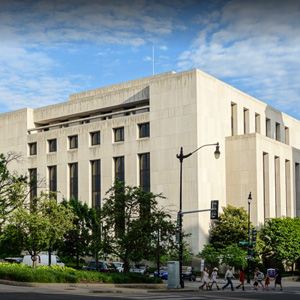
D.C. Bar Names Justice Stephen Breyer as 2026 Thurgood Marshall Award Winner
April 17, 2026
The D.C. Bar has named retired U.S. Supreme Court Justice Stephen Breyer as the recipient of its 2026 Thurgood Marshall Award for his extraordinary commitment and initiative in pursuing equal justice and opportunity for all Americans. Breyer will be recognized at the Bar’s annual Celebration of Leadership on June 18.
“It is a great honor for me to receive this award from the D.C. Bar,” Breyer said. “I joined the D.C. Bar just after graduating from law school. That bar has always stood at the forefront of understanding the functioning of democracy, basic human rights, equality of individuals, and the rule of law in the United States. Those are the elements of our constitutional democracy. The D.C. Bar, by understanding them and helping others to understand them, helps to preserve those elements.”
Appointed by President Bill Clinton in 1994, Breyer served on the Supreme Court until his retirement in 2022. He has since returned to teaching as the Byrne Professor of Administrative Law and Process at Harvard Law School and sits as a judge by designation on the First Circuit Court of Appeals.
During his nearly three decades on the Court, Breyer was known for his pragmatic and thoughtful approach to constitutional questions and how legal rules function in real life, outlining his judicial philosophy in his 2024 book, Reading the Constitution: Why I Chose Pragmatism, Not Textualism.
“The French philosopher Montaine in 1584 in his last essay, ‘Of Experience,’ really foresees the argument we are having now. He writes about it and says [that] life is too complicated, life is too unforeseeable, life is just all over the place. You can’t write a set of laws that is going to capture everything that life will do to you, or the country, or to the law itself, or to government. You can’t do it, so don’t try,” Breyer said in an interview with Washington Lawyer that same year.
D.C. Bar President Sadina Montani celebrated Breyer’s legacy, saying the retired justice has embodied extraordinary commitment to equal justice and opportunity for all Americans “not for a season, but across an entire lifetime.”
“From his early work on the Watergate Special Prosecution Force and the Senate Judiciary Committee, through 28 years on the Supreme Court, to his return to the federal bench in retirement, he has never stopped believing that the law must work for everyone,” Montani said. “That belief has not just been a principle — it has been a practice. We are proud to honor a career that has made it a reality.”
“Justice Breyer’s retirement from the Supreme Court in 2022 might have looked like the closing of a chapter. It wasn’t. He returned to the federal bench in 2025. He continues to write and teach at Harvard Law School. And he has spent his post-retirement years doing what he has always done: making the case — in classrooms, courtrooms, and books — that a pragmatic, consequence-conscious approach to the law is essential to protecting the rights of all Americans,” Montani added. “We are at a moment when debates over judicial independence and equal protection are as urgent as they have ever been. It felt exactly right to honor a jurist who has never let us forget that those debates have real human stakes.”
Breyer clerked for U.S. Supreme Court Justice Arthur Goldberg and taught at Harvard Law School prior to his nomination to the First Circuit by President Jimmy Carter in 1980. He served as that court’s chief judge from 1990 until 1994, when he was appointed to the Supreme Court.
On the Court, Breyer was a central voice in shaping modern deference to federal agencies, notably defending the Chevron doctrine, as well as in supporting abortion rights and limiting the death penalty. In First Amendment cases, Breyer took a contextual, balancing-test approach, particularly in campaign finance and speech regulation disputes.