CLE Institute Explores Duties of Gov’t Attorneys as Public Servants
June 30, 2021
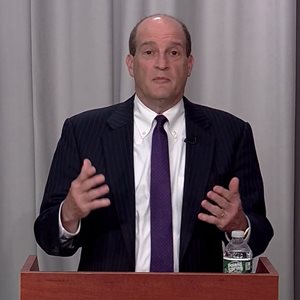 Douglas Letter, general counsel to the U.S. House of Representatives, delivered the keynote address at yesterday’s D.C. Bar CLE Institute on Government Law, a daylong event that covered a broad range of topics relevant to those in public service. Letter, who served under every president from Jimmy Carter to Donald Trump, drew on his decades of government work to discuss the role of government attorneys in protecting and furthering the rule of law.
Letter recounted notable experiences in his career, including the Capitol riot on January 6. Letter was part of the team responsible for certifying the electoral counts from each state in the House chambers when protesters stormed the Capitol. Despite the harrowing events that transpired that day, Letter said the team would return to the chambers later that evening to finish the certification process.
“We completed the task that was assigned to the House under the Constitution and, if you’ll just permit me a moment, that was one of my proudest times to be a public servant,” he said.
Despite his frustrations with some politicians running against Washington to succeed with voters, a “tradition” he found troubling, Letter says he considers public service “a calling, an honor to serve.”
The public servant attorney has several bosses, Letter said. “You serve the agency you’re working for. In some sense you serve the president, the head of the executive branch. You serve the public, the American people — you are a public servant.”
“And, in order to be a government attorney with most agencies, with the Justice Department certainly, you have to be a member of a bar, a member in good standing. I’ve been a member of the D.C. Bar since 1978 . . . and this means that you sometimes have different obligations,” Letter added.
Sometimes those obligations require that you speak up, Letter told attendees. Talking about whistleblowing, Letter said, “I do feel that the federal government attorneys have a very serious obligation that must be kept in mind at all times to provide information when they think there has been a wrongdoing or just incompetence.” Congress needs to know what’s being done with the money raised by the United States, and whistleblower protection helps ensure this is possible, he said.
A breakout session later in the day, “Hatch Act & the First Amendment: Where Things Stand,” cut in the other direction, exploring the restrictions on political actions and speech imposed on some government employees.
William Pittard of KaiserDillon PLLC and Brian G. Svoboda of Perkins Coie LLP examined the Hatch Act’s restrictions on participation in political activities by federal and local government employees, as well as parallel rules applicable to the legislative branch. Pittard traced the act’s history from its origins in the assassination of President James Garfield by a disgruntled job seeker to the Supreme Court cases of United Public Workers v. Mitchell and United States Civil Service Commission v. National Association of Letter Carriers that upheld the constitutionality of the act’s restrictions on freedom of speech.
The decisions provided the act a considerable amount of latitude in its restrictions on speech. Pittard pointed out that a restriction that exceeds necessity is normally destined to be overturned, but the Court found justification for the act’s broad prohibitions. “They may be over-inclusive . . . They may not be necessary to the goals that the Hatch Act is trying to accomplish . . . but that can be a key problem for laws subject to the First Amendment challenge,” Pittard said. “If a law’s getting strict scrutiny, for example, the fact that it is imposing more restrictions than necessary is likely a death knell for that restriction, but in both of these cases the Court said, ‘that’s not a problem here, we’re willing to accept some overbreadth in this area as Congress attempts this balancing of competing interests.’”
Svoboda provided an analysis of the Hatch Act restrictions, exploring the difference in the law’s application to federal employees generally, federal employees with particular roles that raise issues justifying further restriction, and covered state and local employees, particularly those involved in the administration of publicly funded programs.
The rules are somewhat complex, Pittard and Svoboda said, examining the role of the individual, when and where the conduct or speech took place, and what was said or done. The course materials made available to attendees included a report by the Office of Special Counsel detailing Hatch Act violations by the White House Office of Political Affairs under George W. Bush.
Pittard said other branches, agencies, and organizations have their own Hatch Act-like restrictions. Among his practical advice regarding compliance: “You just have to be cognizant of what the rules are for wherever you work because it’s not always intuitive. In fact, it’s often not intuitive.”